
What a medical camp in the Himalayas looks like
Aaron and Debbie Cuha, October 10, 2026. 1 min read.
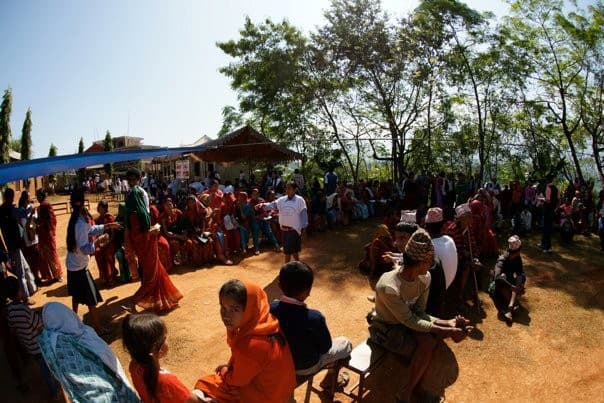
People hear "medical camp" and picture a field hospital. It is nothing like that. It is a village school with the desks pushed to the wall, a banner on the brick, a folding table with every medicine we carried in, and a line of people that starts before dawn.
How it works
We bring the doctors, the dentists, the nurses and the volunteers, and the village brings everyone else. Word goes out a few days ahead through the local health volunteers. By the time we arrive, the whole village is waiting under the biggest tree.
Registration is a laptop on a table and a lot of patience. Then the line splits: medical in one room, dental in another, the pharmacy at the end. Dental is the busiest. In the hills most people have never sat in a dentist's chair, so a lot of the work is extractions, and a lot of it is children.
We sleep in tents on the school ground. Breakfast is whatever the village makes, usually dal bhat. Then we do it again.
The 2010 camp
One banner from October 2010 still reads clearly in our photos: a three day camp in Ratnapur, in Syanja district, run with the Vanetik Foundation and Rescue Humanity, with California Sunset Escrow and Chase Merritt as sponsors. The following year we trekked for nine days with camps in Thulo Syabru, Thambuchet and Tatopani.
We are not going to put patient counts on this page, because the counts we have are rough and we would rather be right than impressive. The honest summary is this: more than half a dozen camps over the years, and thousands of people seen who would not otherwise have seen a doctor.
Why it matters now
The villages where we camped are the villages the August 2026 flood hit. The people in that line are the people whose homes we are rebuilding in March. If you have ever wondered where a donation to us ends up, look at the photos. That is where.